 myIIT
myIIT

INDIAN KNOWLEDGE SYSTEM
D. Narasimha
1. Mathematics
Mathematics has been an integral part of our Ancient knowledge system, though there is no separate Shastra or Darshana exclusively for mathematics. Unlike the Greek tradition, sages gave explicit construction rather than proof of a theorem. First compilation of mathematical results, in the context of construction of Fire Altars, is found in the Shrautasutra of Baudhayana. But he implies that he has stated what was known from tradition. Some of the main results we find there are the relation between sides of a rectangle and its hypotenuse (we learn it as Pythagorus Theorem), rule for computing square root, convenient values of pi as ratio between integers and construction of a circle with area approximately same as a square. Impicit in the work is the concept of Similar Figures and ratio of perimeter to length of a side. This tradition continued with the Sutras of Apastamba, Katyayana and others.
Siddhantika period:
It is believed that Vararuchi, who lived during the Gupta period, introduced the Katapayadi system of representing ten based numbers using Sanskrit alphabets, in his work Chandravakyas. The place value of number probably became explicit from this time. Aryabhatiya, the influential 5th century treatise on Mathematics and Astronomy, included Aryabhata’s innovations like Trigonometry as well as knowledge passed down. The second chapter of this work, Ganitapada, exclusively deals with Mathematics, where Arithmetics, Algebra, Trigonometry and some results in geometry are systematically introduced. ZERO became an integral part of the system. Aryabhata used ten based number system with up to 10 digits to work with large numbers. His Ardha-jya and Kona-jya are our sine and cosine functions, and he introduced Siddhantic Astronomy using his Trigonometry. Subsequently, there have been many works on Mathematics. Notable among them was the Kerala school of Mathematics and Astronomy founded by Madhava of Sangamagrama in 14th century, who gave series expansion to pi and trigonometric functions. We should consider his work as a foundation for Analysis, as a branch of Mathematics. His disciple Vatasseri Parameshvaran Nambuthiri used observations of eclipses to make corrections to the traditional Surya Siddhanta based Parahita system of computation of planetary positions. His work Drigganita was used up to mid 20th century in some parts of Kerala. (Theoretical and Observational Astronomer?)
Though there were many geometrical constructions from time immemorial, probably the last major work in geometry, that we have access to, was by Brahmagupta (Brahmasputa Siddhanta, Ganithadhyaya) in 7th century. This is surprising because Kalpa Shastra is an integral part of the knowledge tradition and many carpenters of last century and earlier times, illiterate in our standards, were the Kalpanacharis well versed with many of the mathematical formulae and contsructions.
Pre Vedanga time
Mathemetics dates back to much earlier times, when it was part of the divine philosophy, complex computations as well as day to day needs. Shunya (or Sira) and Ananta are mathematical concepts but are also needed for self-realisation. In Purusha Sukta of Rigveda, fractions like 1/4 and 3/4 enter in the description of Purusha and the result of adding fractions 1/4 + 3/4 = 1 (the whole).
पुरु॑ष ए॒वेदग्ं सर्वम् ...... पादो ऽस्य॒विश्वा॑ भू॒तानि॑ त्रि॒पाद॑स्या॒मृत॑-न्दि॒वि
ಪುರುಷ ಏವೇದಂ ಸರ್ವಂ ...... ಪಾದೋ-ಅಸ್ಯ ವಿಶ್ವಾ ಭೂತಾನಿ, ತ್ರಿ-ಪಾದಸ್ಯ-ಅಮೃತಂ ದಿವಿ
(Purusha evedam Sarvam ...... Pado-asya Vishva bhutani, tri-Padasya-amrutam divi)
In Yajurveda, last part of Chamaka Prasna has ten based numbers - odd numbers
एका॑ च मे ति॒स्रश्च॑ मे॒, पञ्च॑ च मे ... एका॑दश च मे॒
ಏಕಾ ಚ ಮೇ ತ್ರಿಸ್ರಾಶ್ಚ ಮೇ, ಪಂಚ ಚ ಮೇ ... ಏಕಾದಶ ಚ ಮೇ ... (ekaachame trisrashcha me, pancha cha me... ekadasha cha me... 1,3,...) and those divisible by 4
चत॑स्रश्च मे॒-ऽष्टौ च॑ मे॒ .. द्वाद॑श च मे॒ ..
ಚತಸ್ರಶ್ಚ ಮೇ, ಅಷ್ಟೌ ಚ ಮೇ, ದ್ವಾದಶ ಚ ಮೇ .. (chatasrashca me, ashtau cha me, dvaadasha cha me.. 4,8,12..), indicating that well developed number system was in place at that time. Rudra Prasna and Chamaka Prasna should be treated as a culture representing cooperation between various tribes and ethnic groups (Punjjisheta, Nishad...) and skilled workers (kulala, karmara, rathakara....). The people rejoice that they can grow grains again after Rudra’s work (given in Sri Rudram); possible implication of the 11th anuvaka of Chamaka is that the numbers are required to quantify the amount of grains they were able to grow and distribute to various people involved. I believe that the essence of Chamaka Prasna, along with the use of relevant numbers, was an integral part of the culture, independent of the Varna or caste, and was prevalent until recently. A tradition of rejoicing the Harvest and division between various families existed in some region of the country even upto early 20th century.
Numbers and their ten based representation occur in many places in Vedas and their utility is implied: In 5th Mandala of Rigveda, Atri is the rishi (composer) and deity of 40th hymn. The hymn possibly describes a solar eclipse and the occurence of Mitra-Varuna and Indra appreciating the task indicates that Atri knew how to compute Eclipses. Consequently, we have to conclude that by 4000 B.C. advanced computations was possible.
Pre Vedic time
Baudhayana’s Sulbhasutras discuss the design of fire altars, using non–trivial mathematics. But he clearly says that he recorded what is Strauta (orally passed on). It is possible that the present shapes of Fire Altars of Garhapatya, Ahavaniya and Dakshina agni might have evolved from the method to accurately determine the Summer and Winter Solstices as well as approximately find the Equinoxes (Vishua). This might be a necessity of the population in around 10000 BC, a geological period just out of the mini-ice which followed the Last Maximum Glacial. If you draw a circle on a plane surface and fix a vertical stick at its centre, the shadow formed during the day can be used to determine the time of the day as well as the solstices. An indication of the onset of the then irregular monsoon could be the summer solstice (commencement of Dakshinayana), a time to start the irrigation of barley or wheat. The winter solstice will be the time to store the harvest and keep the cattle in a safe warm place.
Fire Altars as keepers of Time and Season
A traditional method to keep time of the day, draw exact East–West direction for construction of buildings and determine the Summer and Winter Solstice (Dakshinayana and Uttarayana) is to track the shadow of a stick kept vertically at the centre of a circle.
Here is a diagram of the shadows of the stick traced over the year, from a place at a latitude of around 30 degrees North. We might take the circle as representing the Garhapatya (The Householder’s), which, together with the central vertical stick may be considered the fixed feature of Time Keeper as well as indicator of the season.
The stick at the centre of the Garhapatya might be replaced by a fixed stone structure.
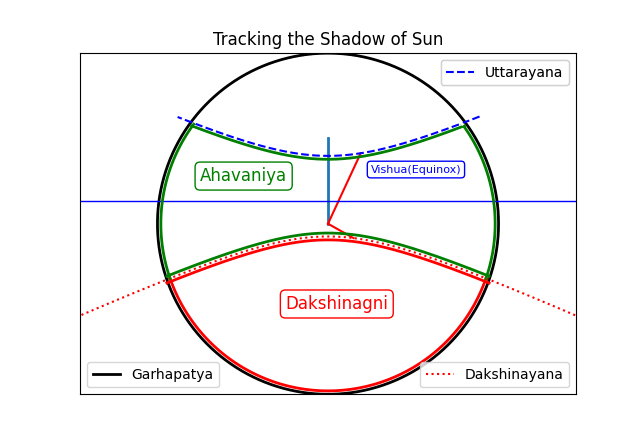
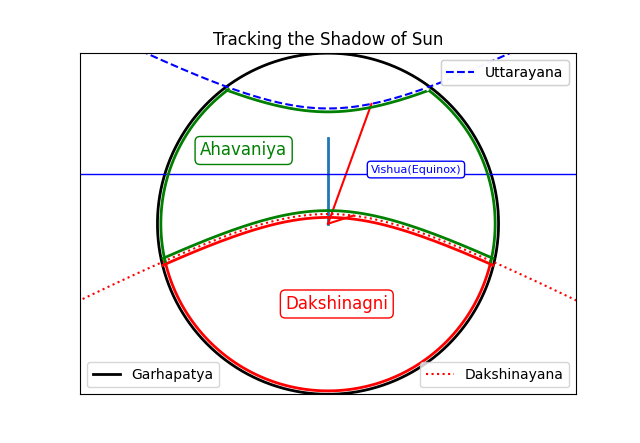
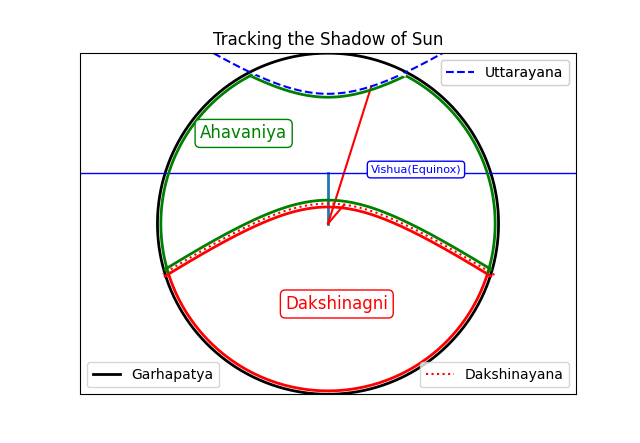
Shadow of a stick at various times of the year: The vertical green line is the stick and the brown line is its shadow at certain time in the morning on Winter Solstice (Makara Sankranti). The dashed blue curve is the path of the shadow of the tip of the stick. The blue straightline is the path on the Equinoxes (Vishua). The dotted red curve traces the shadow on Summer Solstice (Karkataka Sankranti).
The shape of the Ahavaniya and Dakshinagni regions and the appearance depend on the length of the stick, thickness as well as the latitude of the place. They, together with the time of the shadow of the stick, form complex shapes that might be compared with the fire altars of Indus Valley Civilization.
The northernmost curve tracing the shadow of the tip of the stick represents the onset of winter solstice (start of Uttarayana) and the southernmost shadow will be on the day of summer solstice (start of Dakshinayana). The Dakshinaagni Altar could be the shape enclosed between the curve and the Garhapatya circle. It depends on the latitude of observation. The central straight line tracks the shadow of the tip of the stick on the Vernal and Autumnal Equinox. For agricultural purposes, certain time between the Vernal Equinox and summer solstice, depending on the location, might have been chosen based on experience.
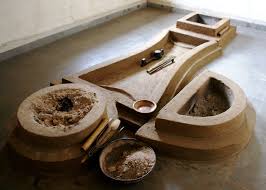
It is possible that Ahavaniya and Dakshinagni fire altars are the smoothened shapes enclosed between the shadows at the solstices and the Garhapatya circle. Here is a schematic present day layout of fire altars, (due to Hamsa Ayurveda - taken from Rupa Bhaty's XR). The sketch might be interpreted as three geometrical structures extracted from the above computer generated diagram for a latitude of around 20 degrees.
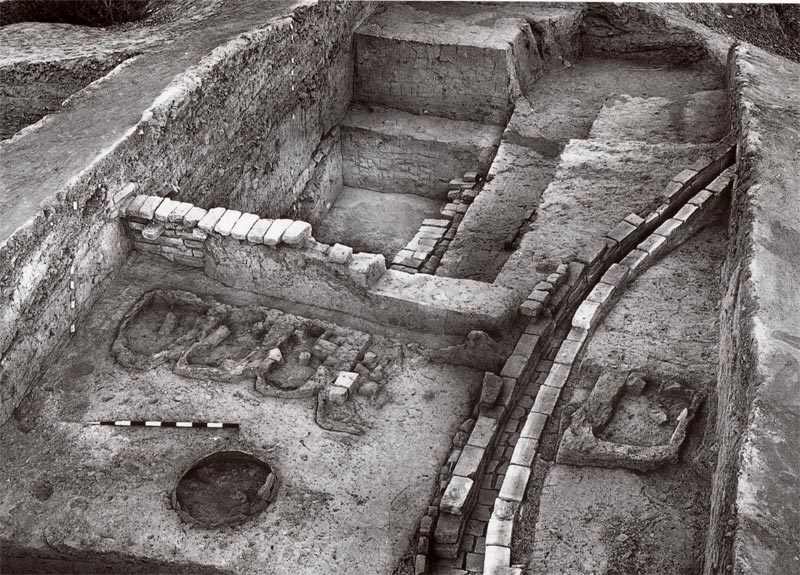 In the 1960's and 70's Archaeological Survey of India conducted excavations at the Indus Valley sites of Kalibangan in Rajasthan and Lothal in Gujarat under the Director Generals A. Ghosh, B.B. Lal and B.K. Thapar. Dr. Thapar's document was uploaded on Penn Museum (Expedition Magazine 17, no.2, January 1970)., where some revealing figures of Indus Valley Civilisation can be found. The fire altars in two Citadel areas at Kalibangan (figure 4 in page 25 and figure 4 in page 27) are shown here.Here are two figures from B. K. Thapar - Expedition 1975 page 25, Citadel area figure 4 and page 27, figure 4. [ Penn Museum: Expedition magazine 17, no.2 (January 1975) B.K.Thapar (1975) Kalibangan: A Harappan Metropolis beyond the Indus Valley] These are from the excavated sites of Kalibangan in Punjab, produced by Archaeological Survey of India.Though the features vary between many such excavated artefects of the Indus Valley Civilization, the essentials of the fire altars are similar.
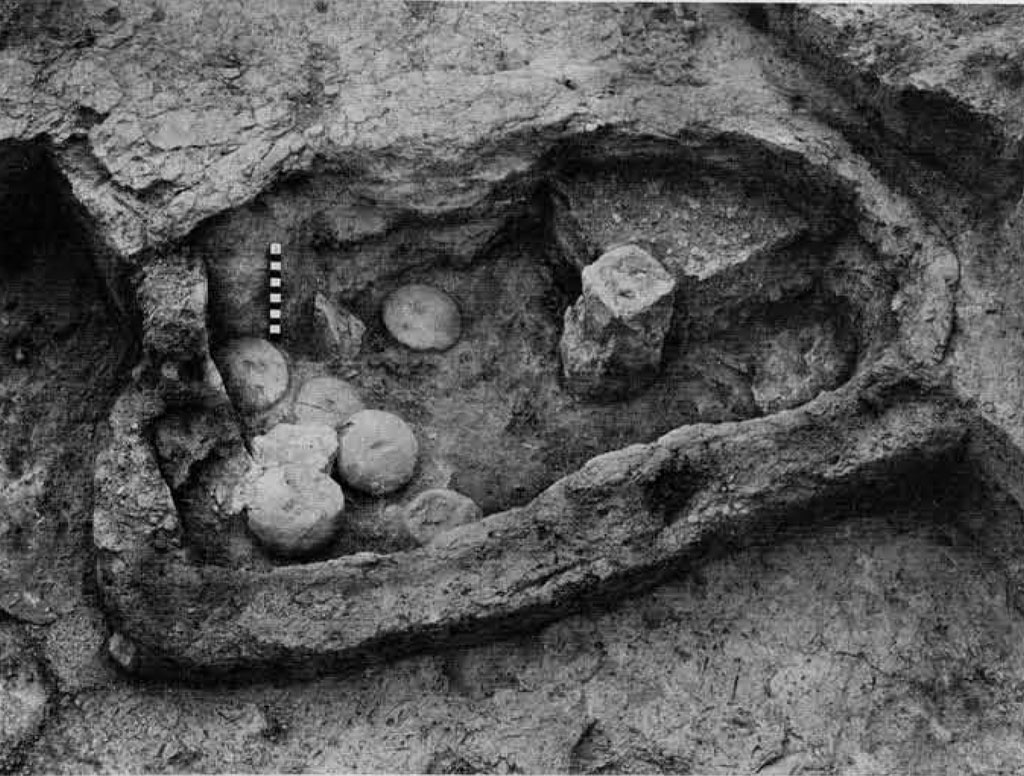 In the first figure, the right side near semi-circle is likely to be the Dakshinagni while the lowermost altar should be the Garhapatya. I interpret the complex firealtar above the Garhapatya to be representation of the various features between summer and winter solstice shadows shown in the previous computer generated graph, specially if a stone pillar was erected instead of a stick. The next figure appears to corroborate this argument.
I interpret that lighting fire in specific altars might indicate the time when water from melting ice or monsoon could be expected and when to harvest and store the grains before the start of the harsh winter of 7000–10000 B.C. This tradition, as an oblation on specific days, possibly continued.
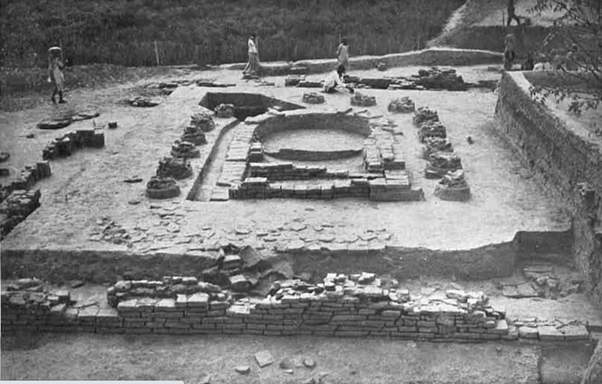
The following figure is from the excavation site in Saunk of Mathura District, carried out by Hartel (1970) for the Archaeological Survey of India. Figure copied from wikipedia: Sonkh_apsidal_Temple.jpg. The layout of the symbolic stones is worth noting. Possibly, the Balikallu stones distributed over a semi-cirle region around the Sanctum Sanctorum of ancient temples of the coastal Tulunadu should be compared with this structure.
The designated Tantri of the region performs certain rite with specific gestures on these Balikallu on specific day of the year. Now, the whole exercise has become annual festival of the temple.
2. Astronomy in Indian Knowledge System (IKS)
Aryabhata introduced Siddhantic Astronomy but the tradition goes back at least up to the time of Vedas. Observationally determining the Winter and Summer solstice is easy but not the equinoxes. We see references to when the solstice occured in Mahabharata and subsequent works. Astronomers kept track of the solstices and probably other events like conjunction of planets with stars or other planets. In Mahabharata, Bhishma waits until Uttarayana on Magha Shukla Saptami, which should have occured around 3100 B.C. In Vedanga Jyotisha of Lagadha, Uttarayana starts at Sravistha (Dhanistha) Asterism in Pausha month and Dakshinayana, when Sun is in Ashlesha Asterism. Aryabhata’s time, onset of Dakshinayana shifted to Punarvasu Asterism. It was due to accurate record of the conjunction of planets, precession of equinoxes
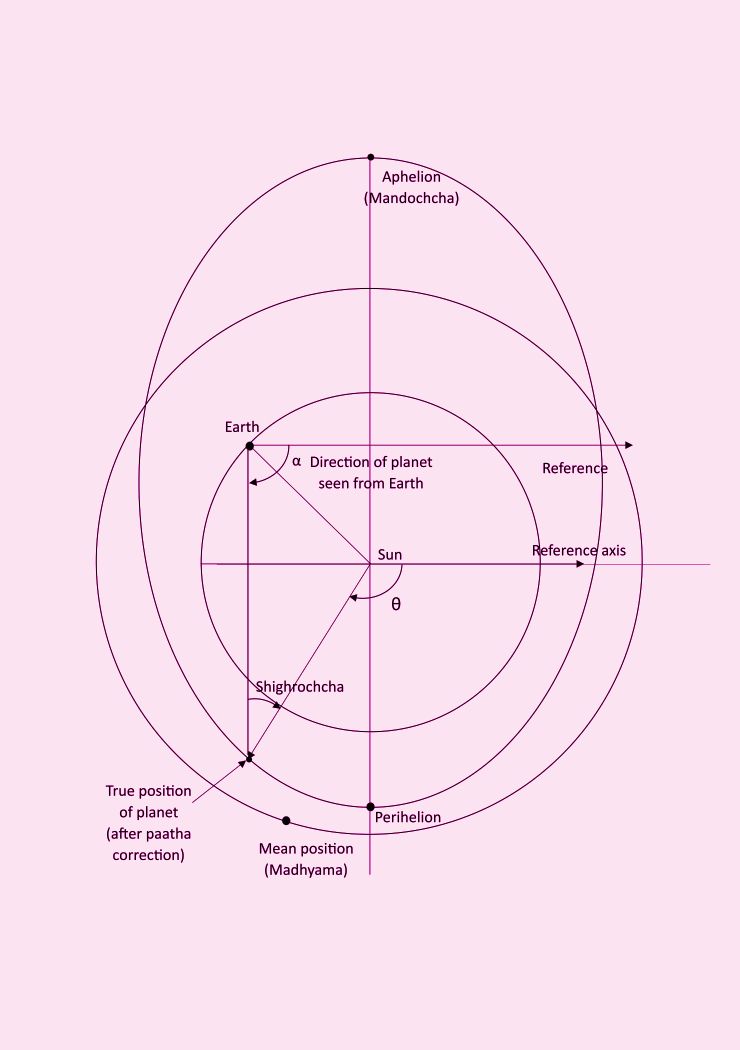
(and equivalently, shift of uttarayana) and the mathematical development that the orbital period of Earth and Planets, shift in the position of their aphelion and intersection of their orbit with ecliptic were obtained accurately. Aryabhata’s value for the sidereal year of 365.2586 days, while Surya Siddhanta based Parahita system, that was used in Kerala upto about 1960, gave the value 365.2584 days. This can be compared with the resent value of 365.2562 days. Narasimha(2016) argued that this difference is due to slowing of earth’s rate of spin, for which there is geological evidence.
After Arybhatiya, there have been a number of astronomical works which gave tables of planetary elements. But some of these works appear to have been influenced by the Greek philosophy of Earth as the centre of Universe. Consequently, their Sighroccha (apex of quick motion) was not as accurate as that of Aryabhata.
Vedanga Jyotisha
Vedanga Jyotisha of Lagadha is a treatise on Astronomy covering the Solstices and the motion of the sun and the moon. Here the winter solstice occurred in Asterism Dhanishta (around 1400 BC) and the year started on the New Moon day. A good fraction of our people still follow the lunisolar calendar of month starting the day after New Moon.
Pre Vedanga Jyothisha
Though not this accurate, we see references to astronomical numbers and events in Vedas. According to R.N.Iyengar (retired Professor, IISc Bengaluru), Rigveda has reference to 3339 day cycle, which he feels, is 9 years of 371 tithis. But it might be 9.3 year half-cycle of Ascending Node (Swarbhanu or Rahu), the intersection of Ecliptic with Lunar orbit.
The 40th hymn of Rigveda Mandala 5 is most likely to be description of a total solar eclipse, which, Atri was able to compute beforehand.
In Mahabharata, we read the reference to Bhishma waiting for Winter Solstice, which occurred on Magha Shukla Saptami (which could correspond to around 3100 BC). Late Professor K D Abhyankar argues that Mohenjodaro seal no. 420 is a representation of vernal equinox, summer solstice, autumnal equinox and winter solstice at the epoch of 3000 BC and the seal no 430 represents the planetary position on 7th February, 3104 BC (start of Kaliyuga). (BASI vol 21, p475, 1993). He uses the folklore on Agastya crossing the Vindhya and dates the event to around 4500 BC when the star Canopas (Agastya) was visible from Vidarbha but not from regions north of Vidhya mountain.
Pre Vedic Astronomical indications
Professor Abhyankar (Presiddhantic Indian Astronomy) goes back even earlier, to 7000 B.C. when winter solstice occurs in Asvini Asterism.
I interpret that, the Garhapatya, Ahavaniya and Dakshinaagni Altars would have evolved from the traditional method of determining the Winter and Summer Solictice by tracking the intersection of the shadow of the tip of a vertical stick with its concentric circle. Moola (origin) Asterism, which has large number of stars might have been used to specify the position of Sun on the day of Summer Solstice (Dakshinayana) and Mrigashira (Head of the Animal) for Winter Solstice (Uttarayana) when this method originated. If accepted, this will correspond to aproximately 10000 B.C., when we just came out of a mini-ice age. This could indicate that in the present Punjab to Gujarat region, systematic agriculture might have started around that time (based on the discovery of fire altars of Indus Valley Civilization). That makes sense because, just coming out of the mini-ice age, monsoon based agriculture would have been the need of the hour. Predicting the onset of monsoon by determining the summer solstice (Dakshinayana) was essential in order to finish the harvest before the land is covered with ice. As a byproduct of this geometrical construction, the East-West direction could be exactly determined, which is used even today for setting up the base for traditional house (Shanku Sthapana).
It should be pointed out that determination of Vernal or Autumnal Equinox would not have been observationally easy (The day is typically about 6 minutes longer on that day near the tropical region, due to refraction and other effects). Tracking the shadow of a stick and determing the day when the shadow moves in a straight line provides an approximate date. Possibly around 2300 BC, the position of Vishuvat - Ecliptic (apparent path of the Sun on the sky) was determined when the star Radha became Vishakha. By that time, Astronomy was observationally, and to some extent theoretically on firm foundation.
There are arguments by some people that Abhijit (Vega)’s importance was because it was the Pole star when systematic recording of astronomical events started around 13000BC. Consider the reference in Ramayana to stars indication of direction. Now here is a reference from Kuvempu's Sri Ramayana Darshanam, Ayodhya Khanda, Shilatapasvini - line around 210.
ತಾರಾಗಣಮೆ ತೋರ್ಬೆರಲ್ ತಾನಾಗೆ, ದೆಸೆಯರಿತು, ಕಳ್ತಲೊಳೆ ನಡೆದರಯ್ ಸಾಹಸದ ಕಣ್ಣೂಹೆಯಿಂ
Taaraaganame torberal taanaage, Deseyaritu, Kaltalole nadedaray Saahasada kannooheyim
[with the star clusters as indicators, finding the direction, they walked in the night with the eyes guessing bravely]
Possibly, Abhijit indicating the North and Mula group of stars or Mrigashira in the Ecliptic, experts should have been able to guess and walk in the dark night
Reference :
- Abhyankar, K.D. 1993: Astronomical significance of two Mohenjadaro seals, BASI 21, 475.
- Abhyankar K. D. : Pre--Siddhantic Indian Astronomy (A Reapprisal) Institute of Scientific Research on Vedas, Hyderabad, 2007
- Website of Hamsa Ayurveda, taken from Rupta Bhaty's XR.
- Härtel, Herbert (1970). Excavations at Sonkh (Mathura District): 1969-70 https://en.wikipedia.org/wiki/File:Sonkh_Apsidal_Temple.jpg (Archaeological Survey of India)
- R.N. Iyengar (retired Prof IISC) in Ramasubramanian, Sule, Vahia (A History of Indian Astronomy: Handbook)
- D. Narasimha: On the length of the year after Varahamihira's PanchaSiddhantika, in International Conference on Oriental Astronomy, 2016.
The Growth and Development of Astronomy and Astrophysics in India and the Asia-Pacific Region, Astrophysics and Space Science Proceedings, Volume 54. ISBN 978-981-13-3644-7.
Hindustan Book Agency 2018 and Springer Nature Singapore Pte Ltd., 2019, p. 247 - Penn Museum- Expedition magazine 17, no.2 (January 1975)
B.K.Thapar (1975) Kalibangan: A Harappan Metropolis beyond the Indus Valley (Uploaded Archaeological Survey of India excavation work of Director General B.K. Thapar)
https://www.penn.museum/sites/expedition/kalibangan